

Reclaiming Growth in Flat Markets
Calling a business "flat" is usually a decision, not a diagnosis. Why mature segments can grow again, and what it takes to stop treating them as cash cows.
Oct 2026
Read article →
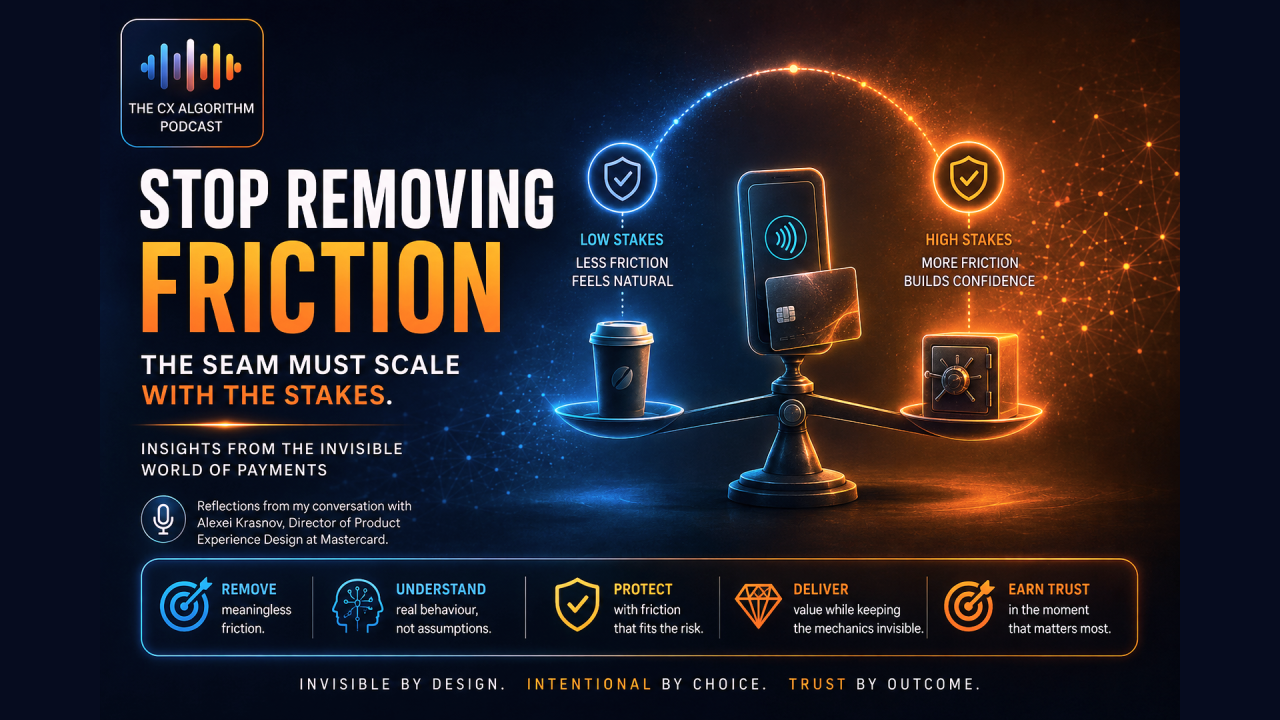
Reflections from my conversation with Alexei Krasnov, Director of Product Experience Design at Mastercard, on The CX Algorithm Podcast.
Think about the last time you paid for something in a store. Not the purchase — the payment itself. The tap, the screen, the colour of the terminal, the half-second of waiting. You can't picture it.
Our profession has spent fifteen years treating that blankness as the goal, and it built a serious case for doing so.
The theoretical case came first. In 1994, Mark Weiser — the Xerox PARC researcher who coined "ubiquitous computing" — put it in seven words: a good tool is an invisible tool. You look through your glasses at the world, not at the glasses. A blind person's cane feels the street, not the cane. Herbert Simon had already named the reason it matters, in 1971: a wealth of information creates a poverty of attention. Attention is the scarce resource being spent at your checkout, and every visible element is a withdrawal from an account your customer never agreed to open.
Then came the evidence. In 2010, Matthew Dixon, Karen Freeman and Nicholas Toman published "Stop Trying to Delight Your Customers" in Harvard Business Review. Across three years and more than 75,000 customers, exceeding expectations made people only marginally more loyal than simply meeting their needs — and 84% said their expectations hadn't been exceeded anyway. They gave us Customer Effort Score, and effort reduction stopped being a finding and became the operating assumption of the discipline.
And subtraction is measurable in a way delight almost never is. In a controlled experiment at Bing, every 100 milliseconds of latency improvement moved revenue by 0.6%. Baymard's benchmarking finds the average checkout carries around eleven form fields where eight would do, and that 17% of shoppers have abandoned a purchase simply because checkout was too long.
Nobody ever wrote a testimonial about a checkout that took four seconds instead of nine. They just came back.
So this is not an argument that any of that is wrong. It is an argument that we drew the wrong rule from it.
Here is the part that should stop us.
Weiser — the founding thinker of disappearing technology, the one everybody quotes — did not think seamlessness was the goal. He argued that making everything seamless amounts to making everything the same, and advocated instead for systems with beautiful seams. The idea was developed further as seamful design: seams that are deliberately visible, because visibility is what gives a person purchase on a system.
The orthodoxy's own author does not hold the orthodoxy. We took half his argument.
The empirical half has been over-claimed too, and I want to be honest about it, because our industry has leaned on that HBR paper for fifteen years without reading its boundaries. It studied service interactions — people who already had a problem and wanted it solved. That is a narrow, specific context. When Dutch researchers ran an independent test in 2015 measuring actual two-year retention rather than stated intention, effort score was the worst-performing metric they tried.
And then there are the two numbers that decide it. Baymard finds 19% of shoppers abandon because they don't trust a site with their card details — slightly more than the 17% who leave because checkout was too long.
Read those together. Too little visible security costs you more than too much process.
The mechanism behind that is well documented. In one study of mobile payment users, 22% of people who chose not to use Apple Pay named "it's less secure" as their main reason — for a technology that is demonstrably more secure than the card it replaces. Remove the visible ritual of safety and you remove the perceived safety, even as real safety improves.
The cost runs in the other direction too, and it is durable. Research on false declines found that after being wrongly declined, 39% of cardholders abandon that card entirely, 25% move it to the back of the wallet, and 32% stop shopping with that retailer. One misplaced piece of friction, one permanent change in behaviour.
Friction applied carelessly destroys value. Friction removed carelessly destroys trust. A universal instruction to reduce it cannot tell you which situation you are standing in.
Seamless is not the goal. Proportionate is.
This is the anchor, and everything else in this piece is in service of it.
Some friction is load-bearing. Remove it and the structure does not get lighter — it collapses. A biometric check or a step-up authentication is not a failure of the design. In a high-stakes transaction, it is the design.
Buying a coffee should be invisible. Moving your life savings to a new account should not — there, the absence of friction is alarming rather than helpful. Money leaves with no beat of acknowledgement and the customer experiences a flicker of doubt: did that go through, did it go where I meant it to? What we designed as elegance registers as loss of grip.
Europe already encodes this as law. The rules under PSD2 don't mandate uniform security; they mandate friction indexed to value and risk — a €50 threshold on contactless before the system asks for more. The Banque de France's own data shows the gradient cleanly: card fraud ran at 0.06% on transactions with strong authentication and 0.18% without it. The friction earns its place.
How the seam should scale:
Trivial and reversible — buying a coffee, reordering a regular. Near-zero friction. Heavy checks here feel like punishment and teach customers to resent the mechanism protecting them.
Routine purchase — light, risk-based, mostly invisible. Over-challenging erodes goodwill without buying protection.
Material and irreversible — moving savings, changing a payee, granting an ongoing permission. A visible, deliberate seam. Its absence reads as danger.
Alexei put the underlying point more bluntly than I would have: "Completely frictionless isn't the holy grail. Customers expect that security — they need that peace of mind."
But the variable underneath the stakes is not effort at all. It is control.
Ask Alexei to name an experience that stayed with him and he describes paying inside a video game — money gone, zero steps — and explains why it felt good rather than frightening: "it's okay, because I am in control."
Zero friction, high trust. Because control was never removed; only the effort was. That is the distinction our industry has collapsed, and collapsing it is how you end up deleting the confirmation step that was the only thing telling your customer they were still holding the wheel.
Or as he summarised it: "It can be seamless, but if it's not trustworthy, it's not going to work."
Precisely where it was measured, and in one more place worth naming.
Someone whose payment has already failed, whose claim is already lodged, whose account is already locked, has no appetite for a designed moment of reassurance. They want it fixed. Every additional step there is pure cost, and Dixon and his colleagues are right about it. The same holds for low-stakes, reversible, high-frequency transactions — strip those to the floor.
Which points at the modifier the whole principle needs: the seam scales with the stakes, and shrinks with reversibility.
There is a striking piece of evidence for this from the agentic-commerce research. Consumers became far more willing to let an AI agent spend on their behalf when they could return the items within seven days. Everyone is building better authorisation screens. What actually moved the needle was a guaranteed way out.
That is the same finding as everything above, arriving from a different direction. What people want before they surrender control is not a slicker permission flow. It is confidence that a mistake can be undone. Build reversibility and you earn the right to remove the seam. Fail to build it, and the seam is the only protection your customer has.
Stop measuring effort in aggregate. Start auditing friction against consequence.
Before removing any step, three questions:
What are the stakes? Trivial and reversible, or material and irreversible? What is this step actually carrying? Nothing, or an assurance the customer is relying on without ever having articulated it? After removal, does the customer still know they are in control? If not, you haven't reduced effort. You've removed agency and kept the risk.
A single number answers none of those, which is the deeper problem with running Customer Effort Score as a headline KPI outside the service desk. Optimise it and you will systematically strip the seams from your highest-stakes journeys — because that is exactly where effort scores worst, and where removing it feels most like progress.
Susan Leigh Star, writing about infrastructure, noted that it only becomes visible when it breaks, and that invisibility is relational: infrastructure disappears for the people it serves precisely because it is enormously visible to the people who maintain it. Your customer's forgettable experience is somebody's very memorable Tuesday.
The organisations that get this right will not be the ones with the least friction. They will be the ones who can tell you, for every seam they have kept, exactly what it is holding up.
🎧 Listen to the full conversation with Alexei Krasnov on The CX Algorithm Podcast — "You Don't Remember Your Last Payment — The Art of Invisible CX." On Spotify, Apple Podcasts and Amazon Music.
Alexei Krasnov is Director of Product Experience Design at Mastercard, working within Mastercard Foundry — the company's innovation and experimentation group — across Asia Pacific. His work sits at the invisible layer of payments: designing the product and payment experiences that move money at global scale, and the trust mechanisms that hold them together.

Dr Eslam Afifi is a customer experience and data leader whose work sits at the intersection of human behaviour, technology, and decision-making. His career spans multiple industries and regions, where he has helped organisations navigate complexity, design better experiences, and make sense of the growing role of data and AI in everyday decisions.

Curious by nature and sceptical of one-size-fits-all thinking, Eslam created The CX Algorithm to explore how customer-centricity actually works in practice.
Weiser, M. (1994), The World Is Not a Desktop Simon, H. (1971), Designing Organizations for an Information-Rich World Dixon, Freeman & Toman (2010), Stop Trying to Delight Your Customers, Harvard Business Review Kohavi et al. (2013), Online Controlled Experiments at Large Scale (Bing latency) Baymard Institute (2025), Cart Abandonment Rate Statistics Chalmers, M. (2003), Seamful Design and Ubicomp Infrastructure de Haan, Verhoef & Wiesel (2015), International Journal of Research in Marketing, 32(2) Huh et al. (2017), "I Don't Use Apple Pay Because It's Less Secure", NDSS USEC Javelin Strategy & Research — false declines EU Regulation 2018/389 — RTS on Strong Customer Authentication Banque de France (2025), Observatory for the Security of Payment Means RTB House / Retail Dive (2026) — agentic purchases and reversibility Star, S.L. (1999), The Ethnography of Infrastructure
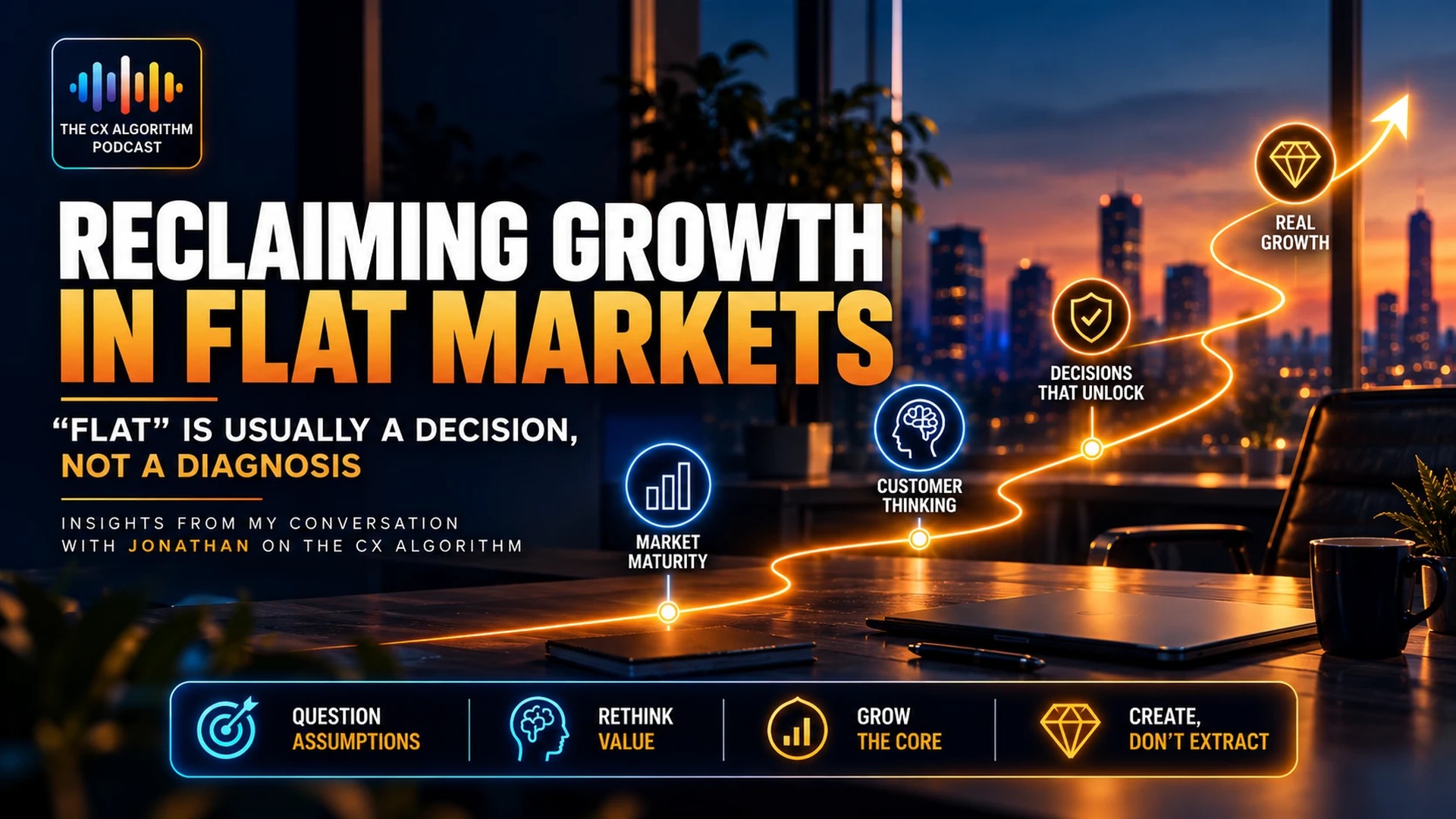
Calling a business "flat" is usually a decision, not a diagnosis. Why mature segments can grow again, and what it takes to stop treating them as cash cows.
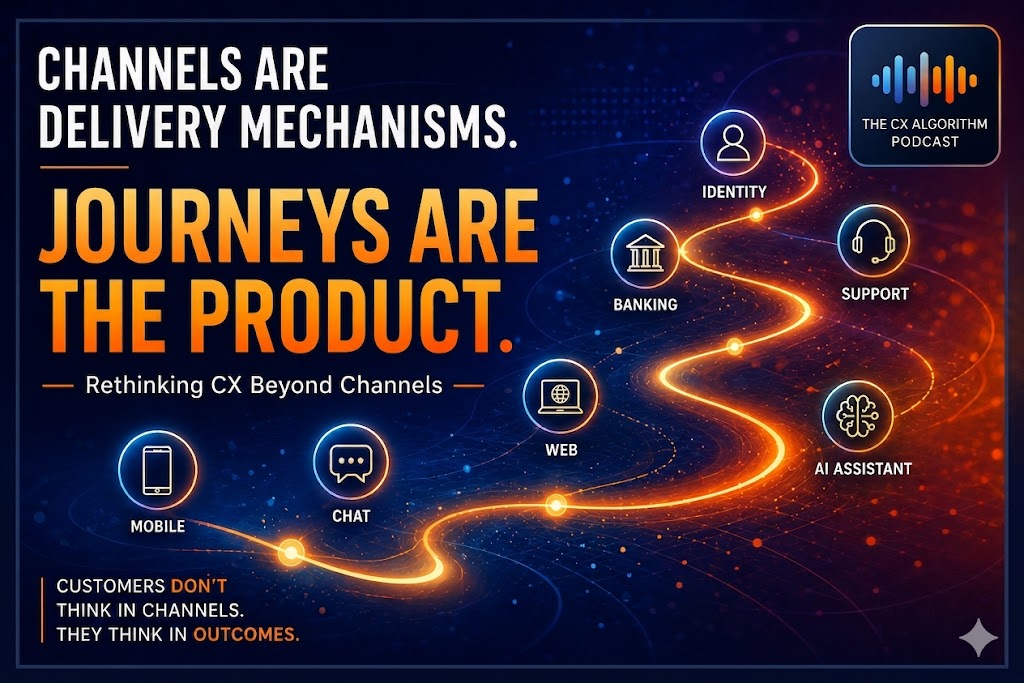
Design around channels and the experience quietly breaks. Customers think in outcomes, so the journey, not the channel, should be the unit of design.

Every CX strategy is an optimisation problem, whether we call it that or not. What energy-grid modelling teaches us about objectives, trade-offs and trust.