

Stop Removing Friction
Seamless isn't the goal; proportionate is. Why the right amount of friction depends on the stakes, and three questions to ask before you remove any step.
Sep 2026
Read article →

"Flat" is usually a decision, not a diagnosis. That is the whole argument.
Reflections from my conversation with Jonathan Rabiei on The CX Algorithm Podcast.
Think about the last time a strategy deck described one of your businesses as "mature". Nobody argued. The word arrived with its own instructions: protect the margin, cut the investment, move the talent to where the growth is.
Our profession has spent fifty years treating that reflex as discipline, and it built a serious case for doing so.
The theory came first. In 1970, Bruce Henderson of the Boston Consulting Group gave us the growth-share matrix and its most famous resident, the cash cow: a business with high share in a slow-growing market. Its surplus cash, he wrote, "need not, and should not, be reinvested in those products." Fund the stars instead. At its peak, BCG says, the matrix guided roughly half of the Fortune 500.
Then came the evidence. McKinsey spent more than a year tracing how hundreds of large companies grew over a decade. The average company grew about 8.7% a year. Of that, 5.4 points came from portfolio momentum, simply being in markets that were growing, and 2.5 points from acquisitions. Only 0.8 points came from taking share from competitors. If you want growth, the data seemed to say, be where the growth is.

And there is a respectable theory of exit. Kathryn Harrigan and Michael Porter showed that when demand is structurally declining, harvesting a business, or selling it early, can be the value-maximising move. McKinsey's work on divestment goes further: most companies hold on too long, and in one study 76% of large divestitures were reactive rather than planned.
Nobody ever got fired for calling a flat market flat.
So this is not an argument that any of that is wrong. It is an argument that we reach for it far too early.
In 2008, Matthew Olson, Derek van Bever and Seth Verry published the results of a study of Fortune 100-size companies over half a century in Harvard Business Review. 87% had stalled at least once: a sudden, lasting collapse in revenue growth.
The finding that matters is the cause. External factors such as regulation explained only 13% of those stalls. "The majority of these standstills are preventable," the authors concluded. They came from choices about strategy and organisation.
One of the root causes they named should make every portfolio review uncomfortable: premature core abandonment. Leaving the core business before its growth is spent, often because managers read operational problems in the core as proof that the market is saturated.
Read that again. Calling a market mature too early is not a response to stalled growth. It is one of its documented causes.

The cost is also lopsided. If a stalled company does not recover within a few years, the authors warned, "the odds are that it will never again see healthy top-line growth." In the book that followed, Stall Points, only about one in ten ever recaptured a sustainably high growth rate.
The mechanism is not mysterious. In 1976, Nariman Dhalla and Sonia Yuspeh argued in HBR that the product life cycle becomes a self-fulfilling prophecy: believe a product is in decline, withdraw support, and you manufacture the decline you predicted. Six years later Donald Hambrick and Ian MacMillan, working from data on more than 200 corporations, warned that "the simplicity of the matrix and its edicts is alluring."
That is the trap. The cash cow was never a description of a market. It was a decision rule, and it can make itself come true.

There is a second reason flat markets catch good companies out. Many never learned how to grow on their own, because the market did it for them.
Go back to that McKinsey figure. If less than a tenth of growth comes from beating competitors, then most organisations spend their good years mistaking a condition for a capability. When the tide goes out, the instinct is to push the same levers harder. When the engine still stalls, it becomes a department's fault, because that is easier than admitting the organisation was being carried.
A booming market hides five things, and each one turns into a cost the moment demand flattens.
Operations. When demand outstrips supply, capacity matters more than productivity. You win by adding volume, and nobody asks how efficiently.
Customers. Fulfilment replaces intimacy. An organisation that is mainly processing orders stops learning what customers will need next. Satisfaction stays high because supply is tight, while the understanding that would keep those customers in a weaker market drains away.
Innovation. Near-term projects win every budget conversation. McKinsey's Three Horizons model says companies must manage today's core, emerging businesses and future options concurrently. Boom years quietly break that rule, and leave nothing ready beyond the core.
The environment. Competitors, new technologies and regulation start to feel like noise. Clayton Christensen documented the pattern: well-run companies serving today's customers while the threat builds just outside their view.
Economics. Volume masks weak pricing and thin margins. Michael Marn and Robert Rosiello showed in 1992 that for the average company a 1% price cut wipes out about 11% of operating profit. Discipline lost in a boom is profit lost in a downturn.
None of these belongs to a single department. Each one makes a market look flatter than it is when the tide finally goes out.

Ted Levitt saw all of this in 1960: "In truth, there is no such thing as a growth industry, I believe. There are only companies organized and operated to create and capitalize on growth opportunities."
Flat markets are real. Most of the flat markets I hear about are not.
This is the anchor, and everything else in this piece is in service of it.
McKinsey's research on experience-led growth found that 80% of the value creation achieved by the world's most successful growth companies comes from their core business. The core is usually where the growth is. It is just harder to see once someone has decided it has none.
So before a business is labelled a cash cow, it deserves the same scrutiny we would give any other claim in a strategy deck. Four questions separate real growth from a tailwind, and they work just as well in reverse, to separate a dead market from a neglected one:
Are we growing faster than the market, or just with it? Compare against market intelligence, not against last year. Are we improving value per unit, or only adding volume? Volume is the market's doing. Value per unit is yours. Are customers buying more because we solve more of their problems? This is the customer experience question hiding inside the growth question. Share of wallet earned by solving problems survives a downturn. Share of wallet earned by being available does not. Do we have a credible plan for tomorrow? For products, services, capabilities and operations, beyond what we already do.
If a leadership team cannot answer those, it has not diagnosed a flat market. It has stopped looking at one.

One story from the conversation captures the method better than any framework.
A new segment leader at a multinational chemical company is handed a mature industrial business in the polymer market. The market is flat. The company treats it as a cash cow. Colleagues, meaning well, advise the new leader not to "rot away" there, and to keep an eye on internal vacancies.
Three years later, that segment is a core business.
Nothing about the market changed. What changed was the method:
Segment the market, looking for pockets of value rather than an average. Go to customers and ask what problems they are working on, and what keeps them up at night. Go to the plants to understand the delivery, quality and supply problems on your own side. Go back to customers and connect the two: what they need against what you can reliably deliver. Write the roadmap, and make it as clear about where not to focus as about where to focus. Spend the years it takes aligning the organisation behind those priorities.
No new channel. No discount campaign. The work started with the customer's problem, which is exactly where good customer experience and service design start, and then made sure the whole organisation could deliver against it.
Other industrial companies have reopened "mature" categories the same way, by changing what the customer is actually buying. Hilti moved from selling power tools to managing whole tool fleets for a monthly fee, and a Harvard Business School case reports customer loyalty five times higher under that model. Fastenal turned the sale of nuts and bolts into vending and managed inventory on the customer's own site. Bossard, rarely the cheapest bidder, moved the conversation from unit price to total cost of ownership.
The product did not get more exciting. The supplier got closer to the customer's real problem.

McKinsey quotes one chief executive who put it in a single line: "There are no mature markets, there are only mature minds."
Precisely where the theory says it is, and nowhere else.
When demand is structurally gone, harvesting or exiting is not a failure of imagination. It is the right call, and making it late is expensive. Porter and Harrigan were right about that, and so is McKinsey about the cost of holding on.
But notice what that argument covers. It justifies exiting a market whose demand is gone. It never justifies squeezing a customer base that still works.
That is where flat markets carry their real temptation. When volume stops rising, the easiest lever is to extract more from the customers you already have: discounts and acquisition tactics replace customer problems, prices rise while value and service fall. It looks like portfolio discipline. It is not.
The test is simple:
If customers notice the change and resist it, you are squeezing. If they notice it and welcome it, you are creating.
Strategy research explains why the difference matters. Adam Brandenburger and Gus Stuart showed in 1996 that the value a firm can capture is bounded by the value it adds. Stephen Vargo and Robert Lusch argued in 2004 that value is created with the customer, in use, not handed over at the point of sale. Squeezing is the firm withdrawing its half of that work while still asking for a bigger share. It works until the next renewal.

Ask most organisations who owns growth and they point at sales. The more sophisticated point at business development as well. Both answers are incomplete.
Sales owns transactions and relationships. Business development owns the pipeline. Neither can own growth on its own, because growth is how the whole company creates, delivers and captures value: R&D and innovation create something customers value, operations produce it reliably, supply chain and quality deliver it as promised, the commercial teams turn it into relationships, finance makes the economics work, and strategy decides where to place the bet.
Customer experience leaders will recognise the argument, because we have made it about our own discipline for a decade. The customer experiences the whole company. Growth works the same way.

It also explains why so many escapes from a "flat" core fail. In one case from the conversation, a manufacturer serving fossil-energy markets set out to diversify into specialty chemicals. On paper it was a growth strategy. In practice every acquisition hit resistance from the core: operations didn't understand the business, innovation teams didn't know the space, and the pipeline wasn't ready. The company has since pivoted elsewhere. A strategy the chain cannot deliver is not a strategy. McKinsey tells a similar story about LEGO, which got into trouble "diversifying into too many adjacencies too quickly" and recovered by going back to the brick.
The chain explains retention too. Most organisations treat retention as something that happens at the exit: the customer signals they may leave, and the discount ladder appears. In B2B the rhythm is familiar. Engagement is high at signing, fades over the contract, and returns at renewal.
Real retention is engineered much further upstream. Another story from the conversation: a chemicals supplier had earned a seat at the table with a large consumer goods company by bringing innovation, around the customer's shift to more sustainable ingredients. What turned that seat into a partnership came next. When the Ever Given blocked the Suez Canal for six days in March 2021, closing the route for roughly a tenth of world trade, the supplier's operations and supply chain teams used a global distributor network to cover the customer's shortages, with no contractual obligation to do so. The relationship moved from being invited to meetings to being hosted at headquarters.
No discount buys that. It came from the part of the company most organisations never think of as retention.

The economics are real: McKinsey notes that replacing one lost customer can require acquiring three new ones. But so is the caution. Werner Reinartz and V. Kumar, studying more than 16,000 customers, found that "the relationship between loyalty and profitability is much weaker — and subtler — than the proponents of loyalty programs claim." The goal is not to keep everyone. It is to keep growing the relationships where you genuinely create value.
And one more lever belongs here: efficiency, but only coupled with focus. Good years leave behind a long tail of programmes that were never anchored in real demand, often a product push with a beautiful business case and no market work behind it. Efficiency without focus makes you very good at things customers don't value. Focus sometimes means the hardest decision in a flat market: stopping programmes.
Stop asking whether the market is growing. Start asking whether you are.
There is no universal Monday-morning playbook for a flat forecast, and anyone who offers one deserves some suspicion. But there is a first move, and it is diagnostic. Before anyone writes the word "mature" into a strategy deck, three questions:
Are we still creating something customers value? Not what they valued when the market was growing. What they are working on now.
Are we delivering it reliably? Operational friction looks like weak demand. Often it is a weak chain.
Are we capturing the value we create? Or has volume been hiding a business that isn't really earning?
The answers live in different departments, each with a reason to believe the problem is somewhere else. That is why the question has to be asked from the top, and why it has to be asked early. The stall research gives you a few years.

The sentence I keep coming back to from the conversation is simple: growth is not a single department; it is the whole company that creates, delivers and captures value.
The companies that get this right will not be the ones lucky enough to sit in the fastest-growing markets. They will be the ones who can tell you, for every business they have called mature, exactly what they tested before they stopped investing.
Listen to the full conversation with Jonathan Rabiei on The CX Algorithm Podcast: Is Your Business Growing, or Is the Market Doing the Work? On Spotify, Apple Podcasts and YouTube.
https://www.thecxalgorithm.com/episodes/is-your-business-growing-or-is-the-market-doing-the-work
Jonathan Rabiei is a global strategic marketing leader in the fast-growing battery materials market, where he leads the teams responsible for strategy, the innovation pipeline, market intelligence and market communication. Over 18 years in specialty materials he has moved from sales and business development into leading growth at global level, across segment leadership, strategic marketing, innovation, a major capital investment, strategic business development and M&A due diligence. He believes growth is not owned by any single function, but by how a company creates, delivers and captures value.
Dr Eslam Afifi is a customer experience and data leader whose work sits at the intersection of human behaviour, technology, and decision-making. His career spans multiple industries and regions, where he has helped organisations navigate complexity, design better experiences, and make sense of the growing role of data and AI in everyday decisions.
Curious by nature and sceptical of one-size-fits-all thinking, Eslam created The CX Algorithm to explore how customer-centricity actually works in practice.
Henderson, B. (1970), The Product Portfolio, BCG Perspectives BCG Henderson Institute (2014), BCG Classics Revisited: The Growth Share Matrix Atsmon, Y. (2017), How growth champions thrive even in stagnating markets, McKinsey; Viguerie, Smit & Baghai (2008), The Granularity of Growth Harrigan, K.R. & Porter, M.E. (1983), End-Game Strategies for Declining Industries, Harvard Business Review McKinsey on Finance (2002), Divesting proactively, No. 4 Olson, M.S., van Bever, D. & Verry, S. (2008), When Growth Stalls, Harvard Business Review Olson, M.S. & van Bever, D. (2008), Stall Points, Yale University Press Dhalla, N.K. & Yuspeh, S. (1976), Forget the Product Life Cycle Concept!, Harvard Business Review Hambrick, D.C. & MacMillan, I.C. (1982), The Product Portfolio and Man's Best Friend, California Management Review, 25(1) Baghai, M., Coley, S. & White, D. (1999), The Alchemy of Growth; McKinsey Quarterly (2009), The three horizons of growth Christensen, C.M. (1997), The Innovator's Dilemma Marn, M.V. & Rosiello, R.L. (1992), Managing Price, Gaining Profit, Harvard Business Review Levitt, T. (1960), Marketing Myopia, Harvard Business Review McKinsey & Company (2023), Experience-led growth: A new way to create value Harvard Business School case, Hilti Fleet Management (A); IMD case, Bossard Fasteners (A) Brandenburger, A.M. & Stuart, H.W. (1996), Value-Based Business Strategy, Journal of Economics & Management Strategy Vargo, S.L. & Lusch, R.F. (2004), Evolving to a New Dominant Logic for Marketing, Journal of Marketing Reinartz, W. & Kumar, V. (2002), The Mismanagement of Customer Loyalty, Harvard Business Review

Seamless isn't the goal; proportionate is. Why the right amount of friction depends on the stakes, and three questions to ask before you remove any step.
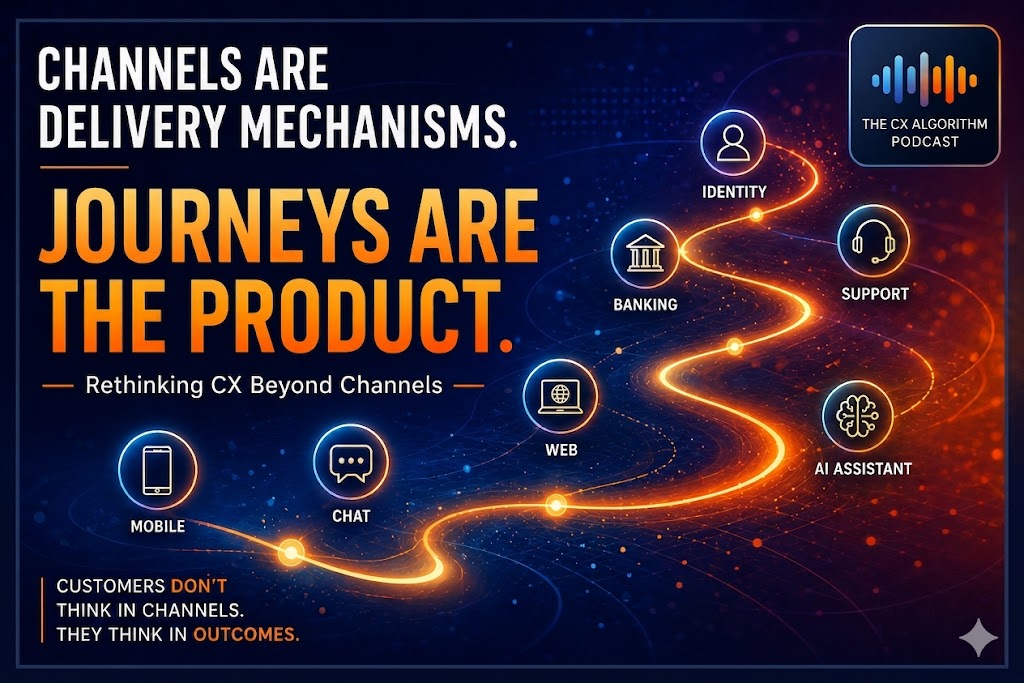
Design around channels and the experience quietly breaks. Customers think in outcomes, so the journey, not the channel, should be the unit of design.

Every CX strategy is an optimisation problem, whether we call it that or not. What energy-grid modelling teaches us about objectives, trade-offs and trust.