

Everything Is an Optimisation Problem — Including Your CX Strategy
Reflections from my conversation with Mohamed Soliman, Regional VP at Energy Exemplar, on The CX Algorithm Podcast.
Apr 2026
Read article →
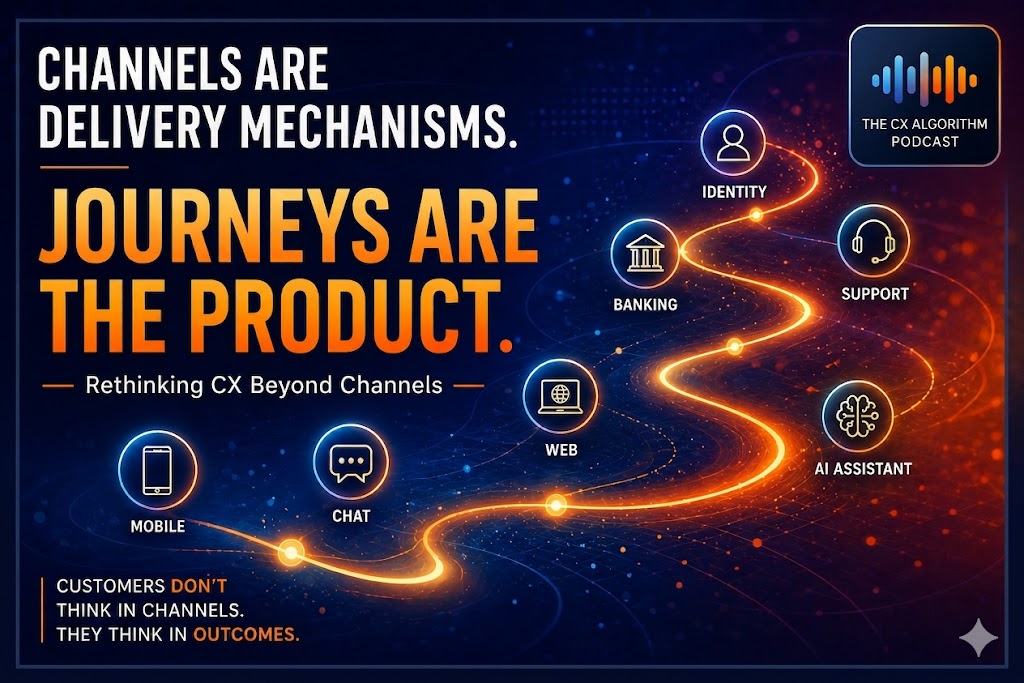
There is a phrase I hear in boardrooms constantly. Every time I hear it, I tell myself I should reward myself with a treat.
That phrase is "channel strategy."
Not because channels don't matter. They do. Your app has to work. Your website has to be good. Your contact centre has to function. But the moment an organisation starts using channels as the primary unit of design, investment, and accountability — something quietly breaks. And the customer feels it long before leadership does.
This was the starting point of my conversation with Sasha Zablotskyi, Head of Digital Channels at Openbank. And what followed was one of the most grounded, practically rooted conversations I have had on this podcast — not because it was theoretical, but because Sasha has lived this from three completely different industries: e-commerce, telecommunications, and now digital banking.
His conclusion? Channels are delivery mechanisms. The journey is the product.
Here is the uncomfortable truth Sasha put on the table early in our conversation:
"Customers don't wake up thinking today I want to use a channel. Customers have a job to be done."
This is not a new idea. Clayton Christensen articulated the Jobs-to-Be-Done framework decades ago, arguing that customers do not buy products — they hire them to accomplish something. According to Christensen et al. (Harvard Business Review, 2016), the question is never what the customer is buying — it is what they are trying to get done. A customer opening a bank account is not thinking "I will start on the app." They are thinking "I need access to my money." The channel is invisible to them. The friction is not.
According to McKinsey, more than half of customers engage with three to five channels during each journey they take toward making a purchase or resolving a request — yet most organisations still measure, fund, and optimise each of those channels separately. The customer experiences one journey. The organisation reports on five disconnected metrics.
Sasha illustrated this perfectly with a story from his time at Eldorado, one of Ukraine's largest electronics retailers:
A customer researches a refrigerator online. Compares prices. Checks reviews. Visits a physical store to see it. Asks a consultant. Goes home. Completes the purchase online. For the customer — that is one journey. For the organisation — that could be the app team, the web team, the store team, and the marketing team all competing for attribution over the same decision.
That, as Sasha put it, is the trap.
This pattern is not unique to retail. According to Forrester's 2024 Priorities Survey, improving customer experience ranked as the number one priority for business and technology leaders — up from third place in 2023. Yet nearly every organisation attempting to achieve it still reports on touchpoint performance, not journey outcomes. The intent is journey-centric. The operating model is not.
One of the most practically useful parts of our conversation was about measurement.
If an organisation measures app sessions, website conversion, and call handle time — it will optimise for app sessions, website conversion, and call handle time. Those metrics are not useless. They tell you whether a specific touchpoint is performing. What they do not tell you is whether the customer actually achieved what they came to do.
According to Forrester's Journey Orchestration Wave (Q2 2024), journey-centric organisations must connect metrics like journey completion and NPS to journey cost, operational efficiency, friction, sentiment, and overall journey profitability — not just channel-level performance.
Sasha's practical version of this for onboarding: how many customers started? How many completed? Where did they drop? How long did it take? How many needed support? And critically — did they become active customers afterward?
He also made a distinction I think is worth sitting with: "A customer can technically complete a journey and still feel confused or unsupported." Completion rate is not the same as quality of experience. Both matter. Which is why journey metrics need to layer quantitative performance (time to complete, drop-off rate, support contact rate) with qualitative feedback about how the experience actually felt.
According to EngageHub and Forrester (2024), 73% of customers now expect companies to understand their unique needs and expectations — yet most CX reporting is still organised by channel, not by what the customer was trying to accomplish. Adding weight to this, Forrester's US Customer Experience Index (2024) recorded an all-time low in CX quality, citing a lack of seamless experiences and disappointing cross-channel handovers as primary drivers. The data and the lived experience are pointing at the same thing.
At one point I asked Sasha directly: is the term "omnichannel" still accurate? Or are we using the wrong language entirely?
His answer was measured, but clear: "For me, channels are delivery mechanisms. They matter — but they are not the customer's mental model. The customer's mental model is: can I achieve what I came here to do, with minimum friction, without starting from zero every time I move between touchpoints?"
According to Renascence (2025), 90% of customers expect consistent interactions across channels — yet the research consistently shows that most organisations are still failing on this basic expectation. Not because of bad intentions, but because the entire system — the structure, the metrics, the funding model — is designed around the inside view, not the outside one.
Omnichannel, as a concept, was always well-intentioned. But it was designed from the organisation outward. Journey-centricity is designed from the customer inward. The direction matters. According to the 2022 State of CX Report via Experience Investigators, CX teams that collaborate cross-functionally are 27% more likely to achieve a high ROI on their CX programmes — which suggests that the structural shift is not just philosophically sound, it is commercially measurable.
The final dimension of our conversation was where it got most forward-looking.
Sasha's position: AI is accelerating the death of channels — because it fundamentally changes the customer interface. If a customer can express a need in natural language and a system can understand, guide, and execute — the starting point becomes irrelevant. The customer does not care whether the interaction began in the app, on the website, or through a contact centre. They care whether the need was understood and the result was delivered.
The numbers show how fast this shift is moving. According to EMA (2025), 73% of global banks have now deployed AI-powered chatbots, and Galileo Financial Technologies (2025) reports that 88% of banking executives believe conversational AI will become the primary customer service channel. According to Santander's own reporting (2025), AI initiatives generated over €200 million in savings in 2024 alone, with AI copilots now supporting more than 40% of contact centre interactions — with a stated roadmap toward fully conversational banking and virtual assistants that resolve transactions end to end.
At Openbank specifically, AI is already deployed in the contact centre and a smarter conversational layer is being developed inside the app. And Sasha shared a vision I found genuinely compelling: a banking app with one button. Use your voice. That's it.
A real-world glimpse of what this looks like at scale: according to Helpware (2025), Commonwealth Bank of Australia's Customer Engagement Engine makes 55 million personalised decisions daily across the mobile app, online banking, and call centres, adapting in real time to each customer's behaviour across touchpoints. The channel is increasingly invisible. The intelligence — and the journey — is not.
But Sasha was equally clear about the risk: "AI can also make the problem worse. If we simply put AI on top of existing silos, we may automate fragmentation instead of solving it."
This is the critical leadership question for 2025 and beyond. Are we using AI to improve the customer outcome — or just to make each individual channel more efficient? Because an AI-powered silo is still a silo. It just moves faster. As PYMNTS reported in 2025, banks that treat conversational AI as a plug-in feature rather than a core strategy risk repeating the mistakes of first-generation chatbots — which achieved only 29% customer satisfaction compared to 60% for mobile apps. Speed without journey design is just faster friction.
Sasha closed our conversation with a line I keep coming back to:
"Fall in love with the customer problem. Don't optimise the channel — optimise the moment of need. Customers don't care where the journey happens. They care whether it works."
That is not a technology statement. It is a design philosophy. And it has structural implications.
If you are serious about journey-centricity — not just as a phrase in a presentation, but as an operating model — here is what actually needs to change:
Stop organising around platforms. Start organising around outcomes. The onboarding team should own onboarding — end to end, across every touchpoint, with the decision rights and data to prove it.
Stop measuring channel performance in isolation. Add journey completion, drop-off rate, and support contact rate to every senior reporting pack. The channel metric tells you how the pipe performed. The journey metric tells you whether the customer got water.
Stop asking "how do we improve our app?" Start asking "how do we help the customer complete this?" The question you ask shapes the solution you build.
And if you are planning an AI deployment — ask first whether your journeys are designed well enough for AI to improve them. If the answer is no, fix the journey first. Otherwise you are building a faster version of the wrong thing.
🎧 Listen to the Full Conversation
Listen to the full conversation with Sacha on The CX Algorithm Podcast — episode title: "Channels Are Delivery Mechanisms. Journeys Are the Product."
xxx

Oleksandr (Sasha) Zablotskyi is a digital experience and transformation leader with deep expertise across e-commerce, telecommunications, and financial services. Currently serving as Head of Digital Channels at Openbank — Santander's digital-first banking platform and now the largest European digital bank by deposit volume, with operations across Spain, Germany, Portugal, the Netherlands, the US, and Mexico — Sasha leads the evolution of customer journeys at one of the most ambitious digital banking platforms in the world.
Over the course of his career, Sasha has worked at the intersection of product, customer experience, technology, and digital strategy — helping organisations rethink how customers interact with digital services in an increasingly connected world. From pioneering Ukraine's first eSIM solution at lifecell (including a cross-company one-minute activation flow built in partnership with Monobank) to building omnichannel commerce at Eldorado, his experience spans the full arc of digital transformation — from legacy retail to modern banking infrastructure.
Passionate about simplifying complexity, Sasha designs digital experiences around customer outcomes rather than organisational structures. His work explores how cross-functional teams, data, AI, and intelligent product design can create more human, frictionless, and continuous customer journeys.
In this episode of The CX Algorithm Podcast, Sasha joins Dr Eslam Afifi to explore why channels are becoming invisible — and why journeys are emerging as the true product of modern customer experience.

Dr Eslam Afifi is a customer experience and data leader whose work sits at the intersection of human behaviour, technology, and decision-making. His career spans multiple industries and regions, where he has helped organisations navigate complexity, design better experiences, and make sense of the growing role of data and AI in everyday decisions. He currently serves as CX, Data & Insights Senior Manager at Acenda (MLC Life Insurance) and holds a PhD in Human-Centered Design & AI and an Executive MBA from IE University.
Curious by nature and sceptical of one-size-fits-all thinking, Eslam created The CX Algorithm to explore how customer-centricity actually works in practice — not in theory. Through conversations with leaders from different contexts, the podcast unpacks the choices, trade-offs, and design decisions that quietly shape customer experience over time. Every episode is built around a single, sharp idea. Because great CX is designed, not declared.
Follow The CX Algorithm for thoughtful conversations on experience, intelligence, and leadership.

Reflections from my conversation with Mohamed Soliman, Regional VP at Energy Exemplar, on The CX Algorithm Podcast.
What does it take to survive — and thrive — through the internet boom, the booking.com wave, and now the rise of agentic AI? I recently sat down with Kate Couling…
Customer experience is ultimately delivered through thousands of small human decisions. A frontline employee deciding how far to go for a customer. A manager…